I’m back in Qatar if you want to have me order the optics.
1 Like
Thanks Chris. I’m in no rush until I’ve finalised things. It’s getting there slowly. I’m having a moment where my head is full to the brim of what has to be done. I still have a lot to do before I start making it. I have to remember I’m essentially building an entire laser system from scratch based on not very well explored research. It’s a research laser rather than a diy take on a commercial system. As far as I’m aware, no one has very attempted to lase stock bought commercial PMMA before. What with no prebuilt enclosure and no prebuilt mounts or stages. I have my work cut out to say the least.
1 Like
This is why its important to check and check again.
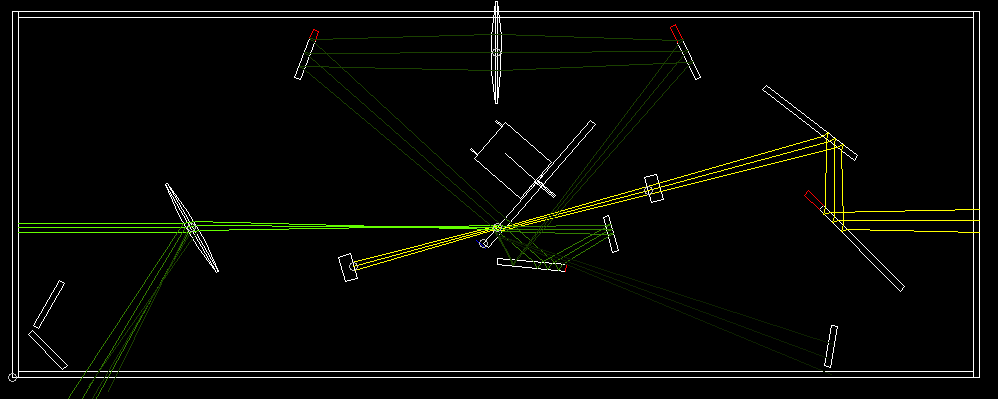
The reflection of the lens doesn’t even match up with the mirrors lol.
Also the back reflection isn’t clean or usable in reality. Both faces of the lens will give off reflection. One diverging and one converging.
1 Like
Good catch.
Can you design some kind of adjustment to the spot the pump diode lands on the PMMA, in case of a burn? Or degradation over time?
I’ve actually done a damage test on a scrap piece of the fluorescent orange with a bdr-209 and was surprised at the result. There was no obvious burning or bleaching. I found that the only mark left was a slight dot where the beam hit a contaminant. That laser is around 800mW iirc with incredible beam specs for burning. The test was carried out with the exact lens I’m using (150mm FL). The PMMA was static too. In the system it will be spun. If you look carefully at the diagram you’ll see that the focal point is actually off the PMMA already. Tilting the pump lens brings the focal point closer to the source. My concerns is that I’m trying to hard to eliminate waste pump power and making the laser a pain to align in the meantime.
A translation stage would allow for movement of the lens to adjust the focal intensity if needed.
1 Like
So as accurate as lenses need to be to get you the desired focal length, it appears my BaK-4 Crown glass lenses have some dimensional variability. My lenses were also simulated in my systems as BK-7 so now they have to change as BaK-4 has a higher refractive index. Plus at each wavelength the refraction index changes again!!! 
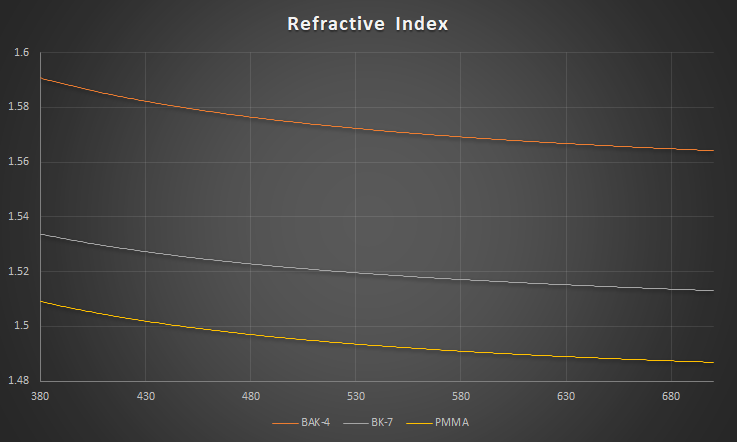
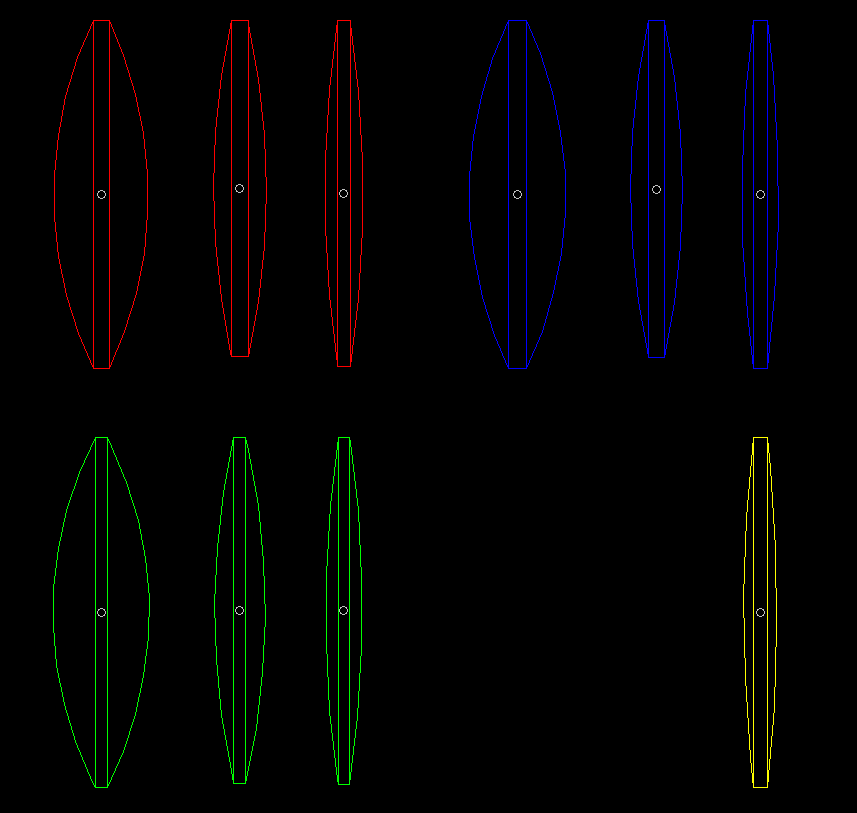
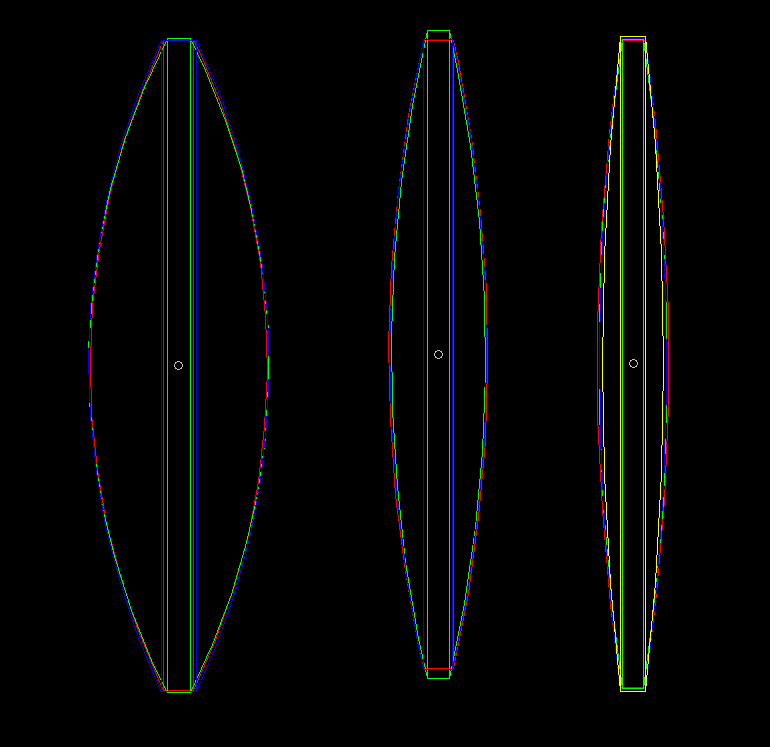
I’ve just spent an eternity sampling, measuring and calculating the focal lengths and radius of curves for a 10 of my lenses to test for focal length discrepancies. I’ve measured each lens using a vernier. I’ve also done real world testing of the CFL (centre focal length) using a 522nm beam expanded of all 33 lenses. The upside is if you guys ever need a spreadsheet that can calculate radius of curve, EFL, BFL and CFL based on CT,ET and diameter then you are in luck. I now have one. 
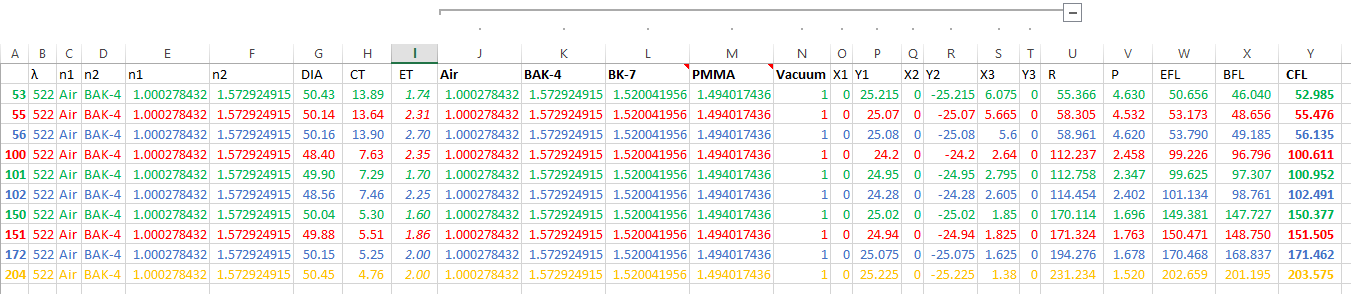
As I said I have 33 CFL tested lenses in my inventory. They were rated and marked up as:
16x 50FL
9x 100FL
8x 150FL
However after testing I found my inventory was more like:
50FL:
7x 53FL
4x 54FL
4x 55FL
1x 56FL
Average FL: 53.9375
100FL:
3x 100FL
5x 101FL
1x 10²FL
Average FL: 100.77
150FL:
1x 150FL
2x 151FL
4x 172FL
1x 204FL
Average FL: 168
The FL150’s I planned to use the most of only 3 actually had a focal length near rated.
4 were very consistently at 172FL, so not sure if I had some FL175’s snuck in or a manufacturing error.
The 204FL lens is a bit of an outlier.
If you are wondering why this is all important. It will be impossible to collimate the exit beam to plan if the FL’s are drastically different. Also lens selection is important. I can’t be placing a 150FL lens in my system for it to end up being 172FL as it will throw all my beam paths off.
So I have to now redraw the laser cavity accounting for real lenses in my stock whilst taking great care with my refraction calculations based on the wavelength of the beam.
1 Like
Oh my lord, manufacturing variables, not nice. Thanks for sharing that piece of information. Good to see you found they are not accurate with their specifications, I had no idea they call a range of FL a specific, but different FL.
1 Like
Yep, look at the dimensional variability on them. I’ve now measured them all so I have a catalogue. Now when I place a lens in my system I know what lens I am using to get accurate results. Not bad lenses though for old educational stock I got free from work.
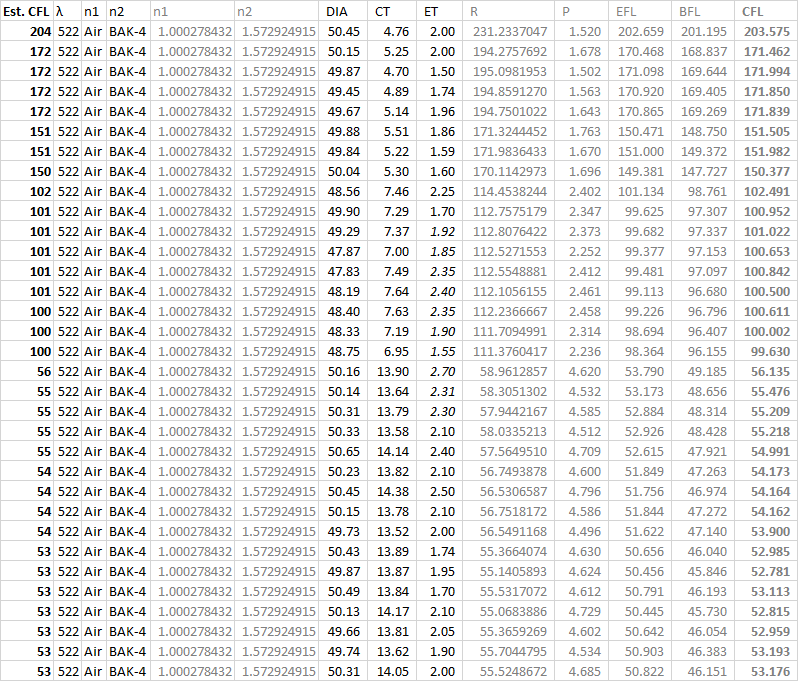
Edit: It has proved useful in some aspects. The pump beam lens could do with a longer focal length due to the lens angle altering the focal length shorter than intended. I previously thought I only had 50,100,150 EFL in my stock. But now I have 170 and a single 200 too. That 200 EFL might just do it.
1 Like
I don’t understand the fluorescent mechanism which produces a coherent output at another wavelength, can you help me understand how that can happen, especially with such a broad spectrum output?
From my understanding, especially when it comes to dye lasers, the peak emission is what is most likely to lase depending on the pump wavelength. If you look at my graphs you will see very clear peaks. Despite this being very broad at times, the linewidth will be shorter as only the spectral region with sufficient gain inside the cavity will lase. Plus refraction within the cavity itself will limit the linewidth further. For instance, in my solid state dye, the PMMA will refract differently at different wavelengths making some of the spectrum misaligned with the optical cavity mirrors. These will then naturally become deselected. What I am supposed to have within the cavity is some kind of tuning element. But the grating needed is expensive therefore it is omitted. The grating would then allow you to alter the cavity to align with the spectral region that would otherwise be non-existent, and would make the peak region misaligned with the cavity allowing also for less competition for those wavelengths. This is why dye lasers have tuning curves. Peak power output will always exist for the peak emission. Power will wane when you tune it to the outer edges of the curve.
1 Like
Can you find a grating which might work on ebay I can send?
The paper from the first post used a birefringence filter which is why I mentioned expense. This is an transmissive optic which is more ideal than a reflective grating.
In the longer arm of the cavity, an optional birefringence-filter (BRF, from a Coherent 599 standing-wave dye laser) can be implemented to tune the laser wavelength.
However, I have just thought of an idea. A birefringence filter is essentially utilising refraction to tune the wavelength. Could I not just get a optically clear quartz plate to do the same thing?
I have no idea if that will work, why not an AR coated prism instead?
An AR coated prism would work except they are very set on angles and would complicate the beam path. The plate would allow the input and output beam to stay relatively parallel, where the prism wouldn’t.
1 Like
That link happens to have three identical size plates at differing thicknesses meaning you could build a multi plate tuner
It looks like birefringence tuners/lyot filters are expensive for a reason due to the type of cut the quartz crystal needs.
Can you use a tight bandpass filter, or would it affect gain too much? I was unable to find dye laser parts on ebay when looking just now. We could ask Starlight Photonics and post in PhotonLexicon asking if anyone has such parts too. Starlight Photonics has lots of crap he doesn’t list.
I don’t think a bandpass filter will work. If you can see if anyone sells a lyot filter/birefringence tuner then it will be great. Then we can potentially have a tuneable solid state dye laser. Depending on whether it lases at all that is. $250+ is what I am looking at atm. They are not cheap.
Does it matter where the filter is centered in wavelength? Or just that it is made for most of the VIS spectrum? I understand it is tunable, but is there a range in the VIS spectrum it should cover?
Edit: I posted on PL asking if anyone knows where to find one surplus: BUYING lyot filter/birefringence tuner
Did I state everything correctly on PL? If not, let me know and I will correct it.
1 Like
As long as it covers the visible spectrum it will be fine. Most are quartz anyway which do. Thanks for trying to get hold of one.